UAE Corporate Tax Law | Federal Decree-Law No. 47 of 2022
Who Is Exempt from UAE Corporate Tax? A Guide to Article 4
Not every entity in the UAE pays Corporate Tax. Article 4 carves out specific categories of persons that are fully exempt. Here is who qualifies, how the exemption works, and what conditions apply.
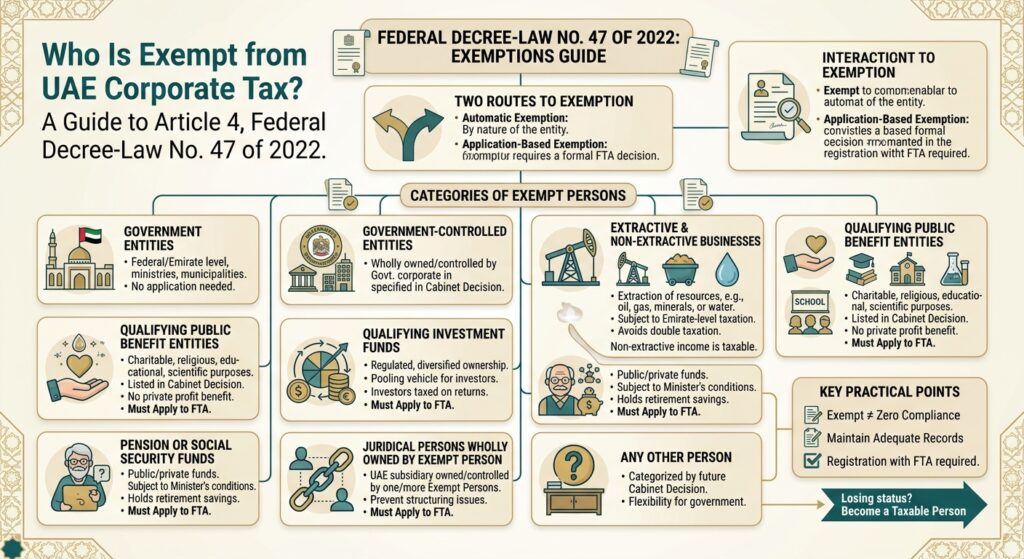
The Two Routes to Exemption
Some persons are exempt automatically by virtue of what they are. Others need to apply to the Federal Tax Authority and get a formal decision. The distinction matters because an entity that needs to apply but does not remains a taxable person, even if it would otherwise qualify.
Categories of Exempt Persons
- Government Entities
Federal and Emirate-level government bodies, their departments and authorities are exempt by default. This covers ministries, municipalities and similar bodies exercising a governmental function. No application is needed.
- Government-Controlled Entities
Entities wholly owned and controlled by a Government Entity can also be exempt, provided they are listed in a Cabinet Decision. The logic: if an entity exists purely to serve a government function and its income ultimately flows back to the state, taxing it creates a circular transaction. These entities must be specified by name in the relevant Cabinet Decision to benefit from exemption.
- Extractive Businesses
Persons engaged in the extraction of UAE natural resources (oil, gas, minerals) that are already subject to Emirate-level taxation on that activity are exempt from Corporate Tax on their extractive income. The idea is to avoid double taxation. If the same person also earns non-extractive income, that portion is not covered by this exemption and falls under normal CT rules.
- Non-Extractive Natural Resource Businesses
Similar to extractive businesses, persons engaged in non-extractive natural resource activities that are subject to Emirate-level taxation on that activity are exempt from Corporate Tax. This covers activities like water distribution or other resource-related operations taxed at the Emirate level.
- Qualifying Public Benefit Entities
Entities established for public benefit purposes (charitable, religious, scientific, educational, cultural or similar objectives) can be exempt if they are listed in a Cabinet Decision. The entity must not conduct activities aimed at generating profit for private benefit. Think of registered charities and public-interest foundations. These entities must apply to the FTA for exemption status.
- Qualifying Investment Funds
Investment funds that meet certain conditions can be exempt. The conditions typically include being regulated, having sufficient diversification of ownership and being managed by a licensed fund manager. The policy rationale: funds are pooling vehicles, and investors themselves will be taxed on returns. Taxing the fund as well would create economic double taxation. The fund must apply to the FTA.
- Public and Private Pension or Social Security Funds
Pension funds and social security funds, whether public or private are exempt provided they meet conditions set by the Minister. The exemption recognises that these funds hold savings on behalf of individuals for retirement and taxing them would reduce the retirement benefit.
- Juridical Persons Wholly Owned by an Exempt Person
A UAE-incorporated entity that is wholly owned and controlled by one or more Exempt Persons (from the categories above) can itself be exempt. This prevents structuring issues where a Government Entity, for example, operates through a subsidiary but loses the exemption at that subsidiary level. The subsidiary must apply to the FTA.
- Any Other Person as Determined by Cabinet Decision
The law leaves room for the Cabinet to add further categories. This is a catch-all provision that gives the government flexibility to expand the list without amending the law itself.
Key practical point: Exempt status does not always mean zero compliance. Some Exempt Persons may still need to register with the FTA, maintain adequate records and notify the FTA if their circumstances change and they no longer meet the conditions for exemption. Losing exempt status means becoming a taxable person from the date conditions are no longer met.